Are there some questions that you can accept or reject? If I reject this question, is it a question? Or am I merely answering the question by rejecting it? It is true that when you really answer a question, it is no longer in question. But how is that different from rejecting a question?
I think all questions involve words and terminology. You can disagree with the terminology used to ask a question. When you do that, are you rejecting the question? Can questions change and still be the same question? Can answers change and still be the same answer?
Suppose I ask “do you beat your wife or are you a sexual offender?”
Most people would disagree with the terms of this question, because the answer is usually neither, and that is not allowed with the English “or”
but only a minor change in the question: “do you neither beat your wife nor are a sexual offender?” makes the terms acceptable. The problem is not the question but the logical rules for “or” that we normally use to answer questions.
Perhaps the best model for the relationship between questions, truth and falsehood is the Jungian model for the relationship between the earth-tree, heaven, and hell.
Carl Jung: “No tree, it is said, can grow to heaven unless its roots reach down to hell.”
In this model we are all trees, as long as we are growing. So if we are asking questions, and asking questions about the terminology in our questions, we are like a growing tree, in the center of the universe. As these questions stretch towards the world, both vertically and horizontally, the tree grows, until its roots reach down into hell and its branches reach up into heaven. Heaven is the truth, hell falsehood. We cannot reach either without asking questions. Rejecting a question is denying growth to the tree, which is necessary to reach the truth, even as its roots continue to reach down into falsehood.
The concept of manly will in Buddhism combines Virya (manly) with Chanda (Will), where Virya is not gender-specific, it simply means “exertion of a strong human.”
“Chanda here means desire to act (kattu-kamata), that is to perform an action or achieve some result. This kind of desire must be distinguished from desire in the reprehensible sense, that is, from lobha, greed and raga, lust. Whereas the latter terms are invariably unwholesome, chanda is an ethically variable factor which, when conjoined with wholesome concomitants, can function as the virtuous desire to achieve a worthy goal. The characteristic of chanda is desire to act, its function is searching for an object, its manifestation is need for an object and that same object is its proximate cause. It should be regarded as the stretching forth of the mind’s hand towards the object.” Abhidhammattha-sangaha
I do not mean will for sensuality, including the desire for the vision of light, or for creation of desirable life. I want to oppose the type of will called “Chanda” with the analysis of qualities, the power of the mind, and subsequent power of the minds material contrivances, to divide concepts and materials. Analysis of qualities is the act of saying “no,” of making a distinction: “this is not that” or “not this, something else.” Chanda, on the other hand is the act of saying “yes”
“It’s a psychological “yes,” a choice, not a pathology” (Ajarn Succito)
The “principle of continuous…invention” that does not allow us to “rest content with a final act of devouring” on stage, but instead makes us continuously try to complete the stage itself, so that the play can begin “a place to stand” is the basic assumption that something can be invented from nothing. This is one of the most difficult problems Aristotle faces in his Physics, and offers a First Mover principle at the circumference of the universe (exactly where nothing begins) to explain this problem.
I don’t think I have ever seen something come from nothing, though. When I invent, things come from other things, put together or “caused” by other things. I have no example of something coming from nothing. It is not necessary that the universe began at all, it is simply necessary that it is to some degree here, now. That is the smallest requirement to avoid nihilism. To say that *if* it is *then* it began somewhere is to put the “then” before the “if” or to reverse causality.
So there is never a situation where the stage isn’t there and needs to be invented. Sure, it might not be the stage we want, we might want to build another stage, but that will only make us start inventing using the stage we already have. It is to do nothing very surprising, because the stage has been changing all along, and will continue changing after we’re done so that things will have to be invented just to keep it the way we want.
Now about the “devouring,” why is the “end” of the stage and play a destruction? What comes to mind is the many mythologies that have an end of the world. Fenris, the great hungry wolf that devours the sun and the father of the gods, Odin, does not begin evil. He is tricked and bound and exiled and made evil, though whether we are good or bad to him, whether his intentions are good or evil, does not change whether or not he will eventually grow to devour all of creation. What changes simply is whether or not this end of the universe is good or evil, and ultimately, neither make any difference. I mean, since we are here, we ought to endeavor to make the end of the world a happy, even blissful occasion, rather than something terrible.
And so the mystical confusion between a duck and a rabbit that Wittgenstein puts forward is the “good” kind of destruction. It destroyed the difference between a rabbit and a duck. It is Chanda, the opposite of “this, not that” Well, that isn’t much of a destruction at all, neither are consumed. It goes on doing whatever it did before, even if the “destruction” or synthesis or vagueness between rabbit and duck is preserved. It could be that the bonds of Fenris that hold him until the end of time are exactly of this type. One of the bonds could be “a duck that is a rabbit” just like one of the bonds is “the air that a fish could breath” which can only be found if a fish is confused or synthesized with an air-breathing animal.
Now, what is the significance of Fenris eating the sun and the All-Father? I think it is Chanda, the type of will other than that conditioned by lust (sexual production) or greed (light production) into something good, even if it means the end of such production. “Consumerism is a synthesis of commercial products and a person’s identification with “mine.”
There is the idea I originally heard from Alan Watts that whatever you are experiencing now is the same as the experience of total enlightenment. The difference is who you are in that moment, or the way you are interacting with the present moment. I don’t think there is any chance that a person eating babies is enlightened, but later that day he could be having a civil conversation and overlap with his “best self”. You may be talking to a person who is both “worse” and “better” than “you”. Who are the people giving the test? what premises are involved in a self-esteem scale, and who would accept those premises? What kind of person would a test giver be looking for in test-takers? There is the ancient and very troubling idea, mentioned by Feyerabend, that counting and measuring people is a way of endangering them.
“He gazed up at the enormous face. Forty years it had taken him to learn what kind of smile was hidden beneath the dark moustache. O cruel, needless misunderstanding! O stubborn, self-willed exile from the loving breast! Two gin-scented tears trickled down the sides of his nose. But it was all right, everything was all right, the struggle was finished. He had won the victory over himself. He loved Big Brother.”
(Ending of 1984)
When I was young I lived in an all-white little town in New Hampshire. I remember reading about black people and their being discriminated against in my social studies book. (this was after my dad came out to me as gay and we had to defend our 9-year-old selves in school with the word dad taught us: “prejudice”) I was really stupified reading that people actually hated other people just because of their skin color. I remember the feeling in my stomach and how I just couldn’t believe what I was reading, but in the next couple sentences it said the civil rights movement in the 1960s cleared that up. The feeling in my stomach went away and I self-righteously decided the world was an ok place to be in, and thought about how stupid people in the past had been. It is mentionable how clearly I remember this when I remember very little in general. Except certain aspects of mathematics and philosophy most everything else just disappears and can’t be recalled. But I remember this.
When I went to school in New York City I went to a very liberal “writing” school where black people were the majority, then Hispanic. I did not make friends with any black people. I also didn’t pick up on any stigma against black people. I felt sort of excluded, and *some* of the black people there spoke and acted strangely to me, but I was a country boy newly put in New York City and the culture shock from that was so overwhelming I didn’t really notice if it was because I was white.
Then there was Syracuse, where some larger groups of Black people tried to pick fights with me and my friends and stole some things, so did some larger groups of white people. And some black people in school seemed perfectly normal. There was a black social studies teacher that used so many big words I was one of the few who could follow him. I still believed what I read in that social studies book so many years ago though. It was a school textbook after all, and I hadn’t seen anything to force me to believe otherwise.
When I went to undergraduate college I had figured out that there was a lot of reason for black people to be bitter about this past, but I still believed it was mainly in the past. I treated black people the same way I treated white people. I even picked up the phrase “hell yeah, nigga” which I would say without directing at black people and without hate, and innocently in front of plenty of black people, until I was confronted and figured out I couldn’t do that. Apart from playing games with black acquaintances, I did befriend one singularly beautiful young black woman, who I loved as a friend and told me bizarre stories of her adventures growing up in haiti and her sexual escapades. There was a funny moment where she got the idea I was infatuated with her, which I honestly wasnt, I was involved with another brown woman, and started telling me she would never date me. But it was a great friendship.
I really didn’t get it through my thick head until I got my first job out of college. Then I really saw racism. Corporate America grossed me out in general. People were exceedingly proud of their surprisingly simple jobs. There were no black men in any capacity. I befriended two black women who became my best friends there. I saw a white guy who I immediately labeled as a moron get hired. Then he put a picture of Reagan in his cubicle, and was almost immediately promoted. On the other hand my friend who is a very smart woman stayed where she was for years. The racism I saw was a major reason why I quit, which I suppose is white privilege. I’m sure my friends would have quit if they had hoped for something better.
There is a long story about how this decision and how my subsequent criticisms of American culture challenged my sanity, that I will not get into here. I will say though, having seen the inside of mental hospitals, that if I were black I would not be able to speak lucidly at all on any subject. They would have crushed my mind and my soul in there, and one reason they didn’t was the stupid #@$#@ color of my skin.
Now that I have introduced how obtuse I can be on this subject, I have to say I still don’t get it. I mean its clear some black people have a pretty different culture from white people, some act like white people, some act like both depending on the situation. The whole topic feels like one for imbeciles. When I see the level of hate and learn about the systematic oppression in the USA, the amount of thought put to hating people based on their skin color, it makes me realize how low the civilization called the USA really is. This is what we were doing as the richest and most powerful civilization in the history of the world? Its mind-boggling what we could have spent our time doing.
What do we do?
It is hard to figure out how to remove this totally superficial and stupid idea from people with power. The fact that racist ideas have infested the CIA and FBI means that there are powerful people in charge of shaping public consciousness who are themselves shaped by security clearance access to racist ideology. It is very hard to access, criticize, and change these documents. Julian Assange mentions how security clearance turns people into morons, because they think their security clearance entitles them to be exempt from learning from people without that clearance. I think the answer for most other people is education, and not of the young. We need intervention with racists as adult education programs that follow the traditions of feminist consciousness-raising. This is what I think, but as this post shows, the whole problem is so dumb that I can’t wrap my head around it.
Now I am married to a brown woman and have beautiful light-brown children, the joy of my life. I owe my pleasant life in part to the color of my skin and the country that I have disavowed. Unlike the guy who got promoted for being white and praising Reagan, I am not comfortable with that.
Sex relies on many superficial considerations, like focusing on the few and tenuous attractions that usually require a lot of concentration to maintain and to blot out aversions/ignoring the many disgusting features of the body. The basic act is mechanical and uninteresting. The verbal and mental work involved in courtship between minds (the concentration involved in maintaining mental sexual attraction and avoiding aversion) is enormous, and without mental attraction, there isn’t much physical attraction either. And the amount of pleasure it produces, while it can be intense, is short-lived compared to the hours of work involved. I am not talking about love, but sexual love and infatuation are not the same, take more to maintain, and are much less rewarding than real compassion and kindness.
The fact that the entire world can be described in terms of sex is not profound. Any pair of opposites can do the same job. Hot and cold (a la Aristotle), form and formless(substance, also Aristotle), limited and unlimited (Pythagoras), continuous and discrete (atomists, Parmenides), wet and dry (Aristotle), same and different (Plato), Being and not-being (many), there is even a famous philosophy book called the Raw and the Cooked which does just fine.
Sex is technically mystical, both in act and thought. It involves the joining of opposites (in this case male and female). Sex is therefore not merely philosophical. However, there are more profound things to join than male and female, such as control and freedom, order and chaos. There is more to be gained from joining control and freedom. You learn how to be act and think freely, and maintain control. That is a better and more lasting gain than a sexual orgasm. I feel that people who spend their intellectual lives cultivating the flow of secretions in their nether regions are a loss to society, much like those who spend their time playing Nintendo. I mean sure, play Nintendo, have sex, compete in sports or business, but at least recognize there are higher callings in life that we should aspire toward sometimes.
I was in a class where the general agreement arrived at mourning over every death that happened every day. I finally had to point out that doing such a thing was impossible and trying would very quickly make you unhappy beyond help. Still, there is the question: when should we not care? When should we care?
For want of a nail the horseshoe was lost
For want of a horseshoe the horse was lost
For want of a horse the soldier was lost
For want of a soldier the kingdom was lost
All for the want of a horseshoe nail.
That this poem is famous tells me we have a misunderstanding about what to care about. To a certain degree you should care about horseshoe nails, or the number of matches in the matchbox, but where exactly the point of not caring is, is a matter of vagueness. The problem of vagueness has a classical characterization that applies to language: if we take one grain of sand away from a heap of sand, we still can call it a heap, but if we keep doing that, we will end up with something we are unsure about, without knowing exactly when we have become unsure! Here the problem of vagueness is not merely linguistic, but ethical. If we don’t take care of little things, at some point those little things will pile up until you find you are a generally uncaring person, and there is no telling when that will happen. What do we do?
This problem calls for strategy. What I tell my daughter is, you care about your bodyweight, or the spots on your face, as long as caring is helping to clear out your mind. Once this caring is no longer helping to ease the mind, you stop. Further, we should care about every little detail *inside our own minds* “How can I improve my intentions, attitude towards this present person, situation, life?” “When I act (because you have to do something about your intentions and attitude) what is the quality of my intention and attitude in the act?” “What tiny fault is there in my own goodness, my own understanding?” These are things you can handle. It is still a very hard and ambitious thing to train yourself to care about, but you can not handle all the deaths in the world.
I think sex, coming from any side is about domination and power. Yes, that makes it related to freedom, but that is about as uninsightful and pessimistic as the phrase “knowledge is power.” Knowledge is almost entirely not power, and sex is almost entirely not about freedom. That makes the relationship sex has to freedom special, but not very helpful for gaining freedom.
Why is sex not so much about freedom? You can gain power with sex, power over your children, power over your partner, power over the opposite sex in general, or the same sex. Sex is often sold in many ways, but there are forces of domination at play in the intellectual circles talking about sex-as-power (often disguised as sex-as-freedom, which is double-talk), and derivative circles, that will probably rob you of any power you might gain from thinking about sex (including gender) or enacting sex.
In the same way that focusing on the individual instead of corporations is a way of controlling people financially, politically, and psychologically, focusing on sexual identity is no different. The main effect of focusing on sex is it limits people’s ability to understand everything else. Just like if you only focus on yourself your ability for compassion and understanding others decreases (though not entirely). People forget more important things like happiness, peace, and an entire spectrum of wonderful human things that, yes are related to sex, but not determined or defined by sex. The secondary effect is groups like male and female and so many others jostle for power and in that setting power-players can play people against each other and keep control. Because sex is primarily concerned with power, powerful people (editors, etc) are able to control the dialogue. Other topics like happiness are not like this.
So if you decide to allow yourself to be pushed into thinking this is the central issue, you are feeding yourself into a patriotic power structure. Shifting to a matriotic power structure is hardly revolutionary to powers that push sex, it is like voting democran or republicrat to fight capitalism.
Once I was in an education class where the teacher was telling us: “when you teach you are wiring the student’s brain.” I asked the teacher: “isn’t learning also losing a connection in the brain?” Say you want to learn to stop drinking. You have to lose the brain-pathways that lead you you drink. So he said “yes, losing a connection or wire in the brain is also learning” and I got a lot of “ahas” from the other students. But the teacher wasn’t going to mention that part.
For me, teaching and learning is asking a question, and then answering it. Yes, that is everything, its almost boring to say that. Maybe you like the learning stages “learning is synthesis and analysis” but actually, that is just as boring and unhelpful. I think the question answer model can be helpful. Education is coming up with a problem you see or that you want to shed light on; or seeing an opportunity for how you want to help with problems in the world. The next part is having the capacity, the energy, and the resources to answer the question or shed light on the problem. All human development comes from that process.
So we are told from on high that education happens in the brain. Well, if learning is wiring and unwiring the brain, both, it might as well be neither. Whats the difference? Learning could have nothing to do with the brain. At all. And all the arguments about learning-as-brain come down to the same basic problem that you know things that aren’t wires or connections or brain pathways. There are non-connections that are not just good, but necessary for a good life, like learning not to go down negative rumination pathways.
Just give your self a moment, where you ask a question. A free moment. And you are free to answer with your energy, capacity and resources, and you can see that learning is not the brain.



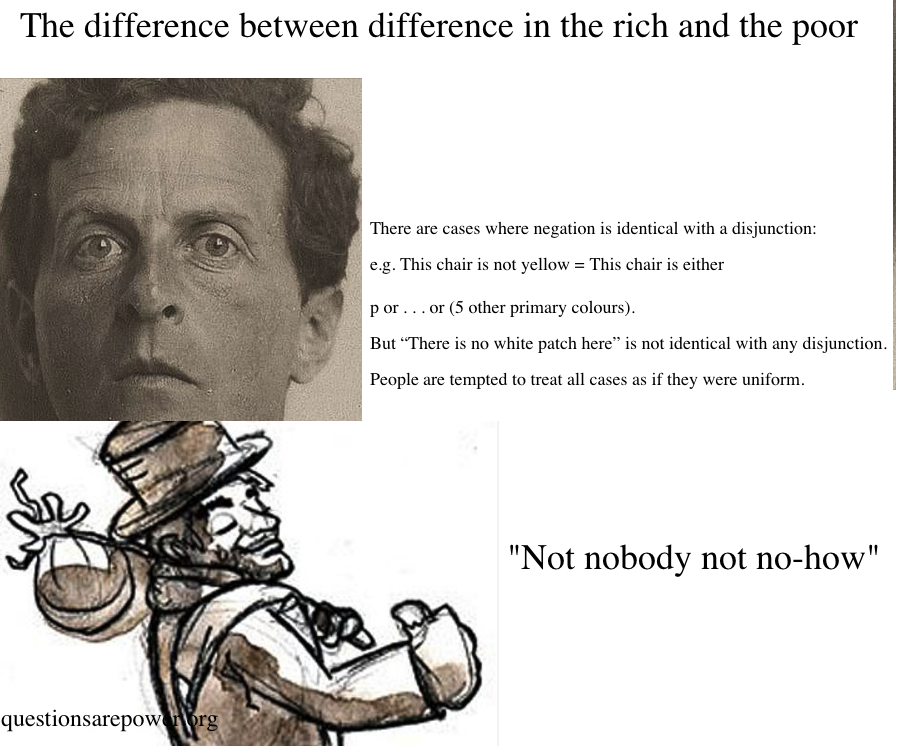
 Questions Are Power