• About

Questions Are Power

Questions Are Power

Category Archives: Questions in Logic

Where are questions, a universal part of language, in logic?

More on the Axiom of Completeness

05 Monday Oct 2020

Posted by Andrew Nightingale in Questions in Logic

≈ Leave a comment

An interesting empirical example of the axiom of completeness is the night sky with a telescope of ever-increasing magnifying power. Take any space of darkness in the night sky and assume you can magnify as much as you want. The axiom of completeness asserts that you will eventually find a star in that space. Take another, smaller space within (not containing a star) and magnify more, you will find another star in that smaller space, or any space, no matter how small*.This, of course, is impossible under the standard physics mandate that there is an edge of the universe and it is not unlimited. In any case the idea of a limited universe is in direct tension with an elementary empirical (if we could inductively continue to magnify) example of the axiom of completeness. The use of stars instead of points gives an alternative to formulating analysis with 0-dimensional objects such as points. They appear like points only at certain levels of magnification.

Another iteration of the axiom of completeness is one in two or three dimensional space. The usual axiom expressed in two dimensions uses objects of 0-dimension: points, and asserts that a bounded increasing sequence (of points) has a least upper bound. Using more realistic objects of the sequence— instead of points, three dimensional shapes such as spheres or cubes—The cubes have to get smaller and smaller, and be contained in the previous cubes of the sequence (after cube N). The problem is that this sequence always contains some space, and asserts that the sequence converges to a point instead of a cube. This is not the inductive inference. The inductive inference requires that all cases that can be reasonably checked by hand resemble the cases beyond, approaching infinity. If the cases known resemble the cases beyond, there would always be some space inside the cube, and the axiom of completeness fails. All this is related to the unrealistic belief in 0-dimensional objects.

  • just for fun lets be precise and say the next smaller circle has 1/4 the radius of the current circle. It is easy to see that this circle can always be found so that it does not include the star you found. Oh, and what if you find two (or more) stars at the same time? leave as an exercise!

28 Monday Sep 2020

Posted by Andrew Nightingale in Questions in Logic

≈ Leave a comment

sand and foam sand and
foam sand and foam sand
and foam sand and foam
sand and foam sand
and foam sand and
foam sand and foam
sand and foam sand and
foam sand and foam sand
and foam sand and foam
sand and foam sand
and foam sand and
foam sand and foam
sand and foam sand and
foam sand and foam sand
and foam sand and foam
sand and foam sand
and foam sand and
foam sand and foam

The Origin of Color

Featured

Posted by Andrew Nightingale in Questions in Logic

≈ 2 Comments

An outlandish red was once discovered, the vermillion knide, on the feather of a lady’s hat. Investigation suggests it may have come from a peacock fed a diet of microphospherous. For the most part, however, photons are not small enough for the total description of the human iris, let alone the mythical iris.

Color is not a leaf.
I wouldn’t put it in a jar
without refining into white powder,
but if you must know, colorful nanoplastics were once used in a mosaic
As big as all seven oceans put together.
(it is well known that such a synthesis is beyond imagination)
The fluid dynamics of watercolor can be caught even in motion.

It was the red ghost star
That showed us the primary primary color
Was more elusive than a silver space octopus.
Yet there are those exalted observers, observing science with science, who
Cloister themselves and meditate on the octopus
That the Venerable Full Professor Doctor Rodimus Vindicatus once caught.
He stood virtually alone in his insight into color,
virtual color though it may be,
Surpassing even a fledgling eagle.

The dance of the two elemental colors, proto-red and electro-blue,
Leave a wreath-vacuum for the neutro-green/neutro-yellow duality to occupy.
The general relative theory of minipigmypigments,
which are even more atomic than atoms,
but not quite as atomic as subminipigmypigments,
take as many tomes as there are rooms in Buckingham Palace.
The base foundation
Of the theory is thoroughly supported by ghost data,
and the death scribblings of Dr Vindicatus himself,
with a probability of one in one ten-thousand.
Nothing is beneath mentioning, but with a probability that small,
we might as well mention it.

The super-Walmart of ideas, by and large,
has seen the theory last the test of the consumer,
who knows such theories take a lifetime to even try to understand,
and longer to communicate. With introspection into four-colordimensional space,
The many happily educated imagine they can almost see red
for what it really is.

The Masters of Meaning

15 Wednesday Jul 2020

Posted by Andrew Nightingale in Questions in Logic

≈ Leave a comment

Who decides what words mean? In a way I believe it was somewhat organic. People used the word for server for a robot (robotiti) as a metaphor, and then that became the word for robot, the metaphor of robotiti “dies” a natural death. But then there is the case of USA politics and terms like “democrat.” (or people like Aristotle who gave new meaning to words like essence and substance in a very deliberate way). I believe words in the USA are kind of like commodities. (the term “organic” is certainly a commodity in the USA) The word democrat starts out appealing to people, and the alternative affiliations being repulsive, people get entrenched under the word democrat. Once the word democrat is “bought” it begins to change: kind of like how a new product uses extra flavoring to start, and once it gains name-recognition, the substance and essence of “democrat” put through the sausage-grinder of US media, gradually reduces in substance and essence the idea of “democrat,” as much as can be gotten away with. It is common knowledge that at one point “republican” was more similar to some current ideas of what a “democrat” is, and this will continue as fast as it needs to to maintain control over voters’ minds.

How do you resist?

We ought to know what meaning means first. “Pending a satisfactory explanation of the notion of meaning, linguists in semantic fields are in the situation of not knowing what they are talking about.” (Quine 1961 p 471) People say a word, what do they mean? They mean whatever it was that they wanted to mean. In other words, I don’t know. If you can figure out even a little of what they meant, success! That is communication. If you talk to someone who thinks meaning is decided from on high and they have to fit their lives into those meanings, then you have to talk to someone who is mind controlled. It is good practice in serious situations to use your mind first and then your mouth, not the other way around. And who decides what words mean? Usually editors and Elite People who are usually interested in consolidating the power of their class or profession, so they are “conservative,” at least as far as that word has any meaning.

Of course there is the problem that people might not know what they themselves mean. I would offer that this doesn’t matter, in a skeptical sense. What appears to person A when they utter a phrase B need not be analyzed by the listener until person A doesn’t know what they mean anymore. It is enough that it appears to person A that “phrase B”, and Aristotle’s eternal project of digging for a subject without a predicate (substance) need not be carried out.

The metaphors of “top down” and “bottom up”, are relevant, as is just about everything, since we are talking about what can be accomplished with language, and how to resist what has been accomplished. People, especially in the USA, are very used to words and their meanings being fixed, and think it is a sign of intelligence when they are used precisely. There is a great deal of anxiety in patients when words like their diagnoses are adjusted in official handbooks identifying (mental) illness. Playing with words is an important way to resist this top down understanding, but in the USA doing so will make you sound mad. As I have said before “English is not a language to play a language game with.” So English speakers in the USA and elsewhere are rather in a bind.

Sexual Identity and the Tao Te Ching

Featured

Posted by Andrew Nightingale in Questions in Logic

≈ Leave a comment

Female/Male is the Yin/Yang of the West. The Tao Te Ching includes a system of description that is basically the binary number system endowed with the meanings of Yin (0) Yang (1), mingling, so “100” is “Yang, Yin, Yin” and has certain intuitive meaning.

The Western Female/Male shows how reducing the world to binary fails: take the terms Manly Female (10), Womanly Female(00), Manly Man(11), Womanly Man (01). And then: Girlish Manly Female (010), Girlish Womanly Female, Girlish Manly Man, Girlish Womanly Man, etc.

What I want to show is how more and more people fall through the cracks as the system becomes more exhaustive. When you get to three digit precision, most people wont identify with any of the terms like “Girlish Manly Female,” etc.

So exhaustive language, precise language, cuts out more and more of reality as “off topic” and people who are too sensitive about what is or isn’t relevant become debilitated when trying to make connections or make sense of the senses (including the sensation of ideas by the mind).

The debilitation of the mind, and the way precision language makes people fall through the cracks of technical terminology (diagnoses, identities, etc) are precisely why they are uplifted by the powerful oligarchs of the USA. Precision language is in no way superior to everyday, or poetic language, except that if you show yourself as someone who follows the rules of mathematics (equivalent to “understanding” “accepting” the rules of mathematics) you’ll get funding, or get published, or pass whatever gate you are trying to pass. It doesn’t really matter what the term “micronutrients” means, what matters is that it is very precise, and by being hypnotized by it, you cut out the rest of the world from view.

The liberal dream of inclusiveness can’t be achieved by a process of refinement of language or symbols, quite the opposite is achieved. The functional use of words is to reduce people’s desire for worldly things, by turning the things into concepts first. Bertrand Russell said that knowing the origin of the word for a fruit increases his enjoyment of the fruit. He is mistaken. The enjoyment he feels comes from removing the enjoyment of the fruit, and replacing it with a different enjoyment of the knowledge of words, which is less visceral, and easier to let go of. This is the way that words are beneficial and useful. If you want to enjoy a person, you suspend judgement in terms of concepts and practices. You suspend the need to know facts that can be expressed with words. In the same sense, as Feyerabend mentions, of the ancient belief that counting people endangers them.

People often find friendship nowadays by feeling that their friend knows the same things he knows. It is a measure of the persons integrity and worth as a person that they have faithfully studied science fiction or some other part of culture. Unfortunately this form of love and companionship is much less than the enjoyment of a person you can have when you don’t need to know that they know the same things. Reviewing shared knowledge of concepts is a way of reducing a felt bond with a person, not increasing it. In a way, we are all going to die, so this pessimistic approach to relationships might be ultimately the right way to go. We are all subject to separation in this world, but that does not mean we shouldn’t fight against this tendency. Success as a human family is not measured by our knowledge of one another, quite the opposite.

The value of the intuitive feelings about Yin and Yang are that they are expansive in an ineffable way, so that they reach the irrational by including each other, and everything else. Male and Female may be able to join in sex. Sex is the kind of irrational and mystical union that we can know the most about. Knowing is at best unimportant, when it comes to irrational wisdom and mystical union. More likely, knowing with concepts and names is destructive to union between man, woman, black, white, gay, straight, etc

Our union is not found in the cracks between these concepts, it is found in the space that makes the view of concepts and their boundaries possible.

Trash

13 Saturday Jun 2020

Posted by Andrew Nightingale in Questions in Logic

≈ Leave a comment

Trash

I will be the one you throw away.
I will do that for you.
When I was thrown away, I used to become dirt,
But now trash is dirtier than dirt
Because it is preserved in landfills.
“Still-recognizable-25-year-old-grapes,”
Says a university-produced heavy-analyzed language-substance, saying,
That art is forever,
At least, recognizable,
As an image of a
—a single-serving
Building kept in its wrapper, keeping in a city, keeping
In the fake snow, and
“That dirt is organic!” says the mathematical salesman with the fake
Little book of poems,
Where he decries his daily consumption
of babies.

The namelessness of everything

27 Friday Dec 2019

Posted by Andrew Nightingale in Questions in Logic

≈ Leave a comment

I have a few children’s books that are very precise about animals. Alina has learned to ask “what is that?” and expect an answer that is “real”: “thats a Northern Cardinal.” Some people feel really satisfied by knowing an animals “true” name. What I do when my daughter Alina demands something more than “thats a red bird” is “well people call it a Northern Cardinal, but this particular Northern Cardinal’s left leg is a little longer than his right, and there is no name for that.” Its like when Thich Nhat Hahn was asked by child “what color is that tree?” and his answer was “its the color that you see.” He explained that he didn’t want to replace the child’s experience of the tree with something else, a word, a concept. The Northern Cardinal visiting your yard is not a Northern Cardinal; it is the bird you see. The Buddha shrine is not an image of the Buddha. My Buddha statue in my house has a most unusual head, with a golden spike coming from the top and pointing up, and the rest of his head is black and knotted and bumpy, except for his face. If you forget it is an image of the Buddha, but an image of a human being not unlike yourself, you can learn a lot from this image. What can a bird or an ant teach you, about being a bird or an ant, if you forget what you think you know about them, like “what” they are by their name?

Look at a cockroach, for example. Imagine being a cockroach. Would you protect your life from a predator, and crawl below the surface of the sidewalk for shelter, even if it lead into the sewer? Of course you would, because you would think you’re life is good and worth protecting. This insight is not available to people who dismiss a cockroach with a technical name, or worse, try to kill them; both acts are ignorant. I invite you to pit yourself against the lives of cockroaches with all the conceptual knowledge necessary to kill as many as you can, and I hope after while you will see that the cockroach will find a shelter you cannot reach. It will survive all the names you give it, even “it”. For this, I am grateful to the cockroach.

Identity is important for logical reasoning. We have to have objects and identities for logical laws to be about something. Strangely, the laws themselves create the identities the laws are to be about, not the other way around. What I mean to say is, with the law of excluded middle (either it is p or it is not p): either a human is male or female, is a part of a human’s identity–  not because we went out and asked people what their identity was, but because logicians need us to be that simple, so they can depend on their logical laws, and publish what they think they know.

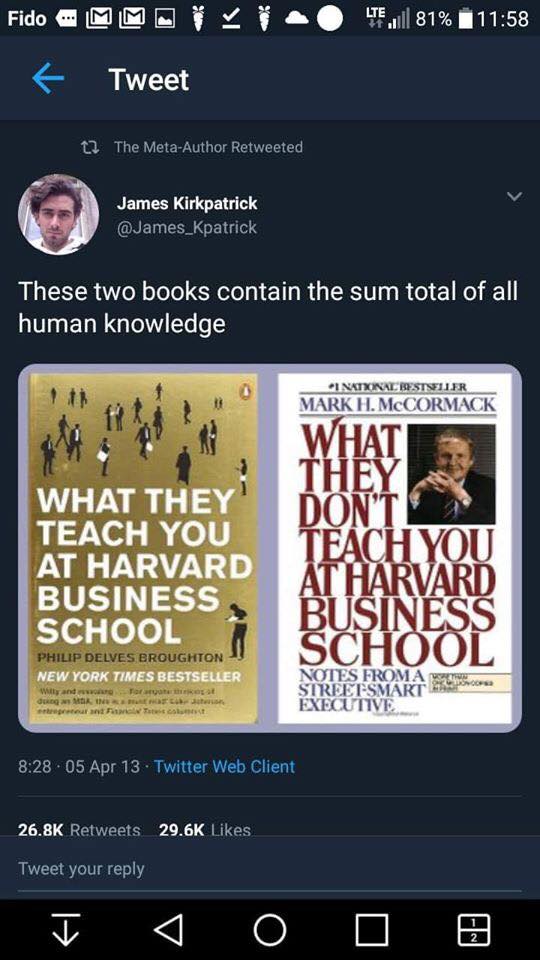
But the cost of the Law of excluded middle is a great cost. The knowledge we think we  gain is largely vapid and empty:

sumofknowledge

The law of excluded middle excludes every shade and color that can impress the soul. It is an about-face from any instructive experience that one could pay attention to. But the worst damage is the Law trivializes our thoughts into overly simple formulae.

The real number system has been painstakingly built and demonstrated logically because some people want to imagine that any point in space has a name. Maybe its name isn’t “one-third” or “0.2145…” exactly: you could make other sounds with your body’s inside noises. The point they want to make is that these points in space can be singled out with some name or other. If you would like to see how this attempt fails, I direct you to my essay Many Roads from the Axiom of Completeness (2013). The desire behind identity, regardless of what bodily inside noise you use to designate that identity, is extended here to other things besides numbers.

Also, it is good to be reminded that all the names we know are not any real kind of knowledge, even if one already knows that “in name”.

The woodpecker is a kind of borderline case because it is both a name and a description. Even for these types of names, seeing, hearing, smelling this woodpecker peck wood is real knowledge. The animals don’t need those names, they don’t need the name woodpecker to peck wood. People who like to watch or care for animals will already know a lot more about what its like to peck wood, and don’t need those names. Its the person who clings to this type of “knowledge” that needs them. People think they are doing a good thing, even an ethical thing, by calling each thing by their “proper name”. They can get rather righteous about it, but actually they are only clinging to an ill founded desire, or needing, to know names that that are of no consequence. The name Northern Cardinal is of no consequence. Recognizing this bird, its relationships to others you have seen, and understanding it, the way I tried to understand a cockroach above, this bird’s condition, way of behaving and expressing, regardless of what you decide to call it, that is real knowledge.


Shrine

I have something to say
And the old words show a way
But the way I am bound
There are no words to be found.

Gotta unthink the unthinkable
A hope, another lie
Its a different point of view
The liar said he would fly, and then he flew.

Hard bind like a railroad line
Face the race and step out of place, yeah
Hear the bell rhyme
In the middle of your mind

Our poem crows a broken joy
That’s changed all its lines
So I built this shrine with the help of Father Time


The limit of the question

06 Friday Dec 2019

Posted by Andrew Nightingale in Questions in Logic

≈ Leave a comment

Once I was speaking with my step-father and he told me about how the Buddha attempted to describe the size of an atom by comparing the sizes of things available to the senses, and multiplying that relative smaller size many times. My step-father was convinced that the Buddha knew the size of an atom and had got it in line with scientific knowledge on the subject. Whether or not Buddha got it right in this case I think is beside the point. The point is that the Buddha went no further than this. He described a smallest particle and asserted that it was smallest– atomic. This is not in line with the current scientific attitude. They find a smallest particle and then the race continues to find yet a smaller one.

I believe the Buddha stopped at his smallest particle and looked no further for purely ethical reasons. He was putting a limit over the domain that he would protect with his religion and his dhamma. He didn’t say so, but going further, or smaller, than his smallest particle, as an act of body, speech or mind, puts you outside his protection and his teaching.

Now we turn to the consequences of our splitting the atom– first with mind, then with speech, and finally with body, we put the entire world in danger of going up in flame. In our case, the Buddha’s teaching on heedfulness is in a sense largely unhelpful, because the fear and peril of nuclear war is paralyzing. And yet scientists seem to believe that continuing their inquiry further and further to ever smaller particles would somehow save us, rather than just put us in more danger. I don’t think scientists have anything reasonable on why their pursuits should not just put us in more danger. Danger of poisoning our water, our land, danger of WMD, pandemics. Quantum computers are great, but what about Quantum bombs? News treats scientific “progress” with wonderful possibilities for technologies, but rarely treats the way a new idea can be misused and misinterpreted to serve people who are less well-meaning than the truth-devoted ideal scientist. When will we stop uncritically allowing scientific ideas into our societies?

And the question may be put to the Sangha, whether the threat of nuclear war, which seems rather abstract involving particles I can’t see and causal relations between presidents and cultures of people I am removed from; whether this threat that I may at any time go up in flame or some of my friends may burn, or that my friends might feel the pain of their friends dying in fire, is relevant to the here and now? In other words, is it Dhamma; is it a real threat? Is fear of it justified? It may seem that we should just pay attention to what is before us and pretend that splitting subatomic particles just isn’t, in the present moment, a real problem. If we do that, and end up burning, should we look to our past karma as the cause, and not the strange modern predicament that we hear about on the news? It seems that this is a clear impasse between Buddhism and modern society, and that “what is relevant?” “What is Dhamma?” is actually in question, rather than immanently apparent.

There is no service in denouncing scientists for their actions in creating WMDs, nor is there service in finding fault in Buddhist doctrine in how it helps or hurts us in our current plight.

The serviceable question is what do we do now, that we have irrevocably put ourselves in such a danger that heedfulness, inquiry, and knowledge are no longer unequivocally good.

I believe what we should do is to inquire into where the ethical limits of our knowledge ought to be. Obviously, subatomic particles in isolation, as particles of an atom, should be recognized as an unethical idea. It does not matter if subatomic particles are “true” or “real.” Any lie is “real enough” or has some truth in it, otherwise it would not see the light of day. Realizing that any lie has truth in it is unhelpful, it is a realization that will do more harm than good, even though it is true. In the same sense, a subatomic particle is a terrible lie, or a harmful truth, and, as Buddha must have realized, we must set a boundary against inquiry in this direction. We have enough technology to feed us and care for us. What we need is the sanity to recognize we have enough food (and to start sharing it); to recognize how small is small enough, how much truth us truth enough (and how little truth constitutes a lie), how much heedfulness, inquiry and knowledge is enough, when to speak of truths, and when a truth should remain unspoken, and left outside our motivations for action. After all, using small technical words such as subatomic particle restricts our speech to only a vary small aspect of the world. In other words, it is more unreal than real, less about the world and more about something else.

The wisdom of the Buddha is seen most powerfully in recognizing when he chose to be silent. He was silent on all things except on how to end suffering for oneself. The time to thoughtfully and powerfully set limits on scientists’ ability to invade one’s own thought, speech and acts is overdue. The noises we make should not be an endless refinement of technical language on ever-refined “particles” or “quanta,” but noises that quiet the noise. The sound of the singing bowl is one such noise.

I believe my book is another such noise.

Bravery, Perfection, Skepticism

06 Sunday Oct 2019

Posted by Andrew Nightingale in Questions in Logic

≈ Leave a comment

“If you’re going to do it over-do it, that’s how you know you’re alive” -Ani Difranco

So we see famous people over-doing it all the time. Published works are generally over-done, or they wouldn’t be published. It falls under the general ailment of American society, seen in abundance in my field of mathematics, that technique replaces everything else. Substance, profundity, immanence, and what actually serves society, is replaced with attention to detail and over-work. And this ailment is ultimately driven by fear. People get convinced that they need attention, they come into the world with a job to do, a job that they’re good at, but because of an environment of competition, they are afraid that they’re work wont get done, because it will get ignored. A lot of things that are over-done don’t matter much. Nintendo? Game of Thrones? “Pro” wrestling? Some things that matter a lot are so over-done that they lose their potency, such as bills that are negotiated in the American government. They get rhetorical names, but their contents are like, I believe the metaphor the media likes is ground up sausage. Look at Obama-era health care bills. They managed to rearrange some things, it did help some people in very important, life-saving ways, and it made the private medical companies’ stocks go up. What was it? I admit I am not enough of a fanatic to find out, and if I were, the burden of communicating what I found would be immense. It was over-done to make it “dark.” People can be more easily manipulated, or forced into their already entrenched dogmas, because they don’t understand what is going on.

Is academia different? I’ve heard it said that academics are basically politicians, I would add that they tend to be more soft-spoken and polite politicians. Social constructivism is an obvious example, obvious because it is honest about being political. Other paradigms are just as political.

I have become convinced there is nothing new under the sun. Everything has been said at least indirectly. The things that really need to be said have been said before, but they need their expiration date renewed. The resistance to it, if its worth saying, will be actually be political, but the arguments will be technical, and if you want to get published while going against the stampeding herd, you have to be meticulous and over-do it. That is why “work” is an unassailable ideal in academia. Just call it “jobs” and you’re a politician.

One very important consequence of this system is that interdisciplinary works get ignored because they cannot follow the techniques of a given discipline as well as narrowly-focused work can.

I think Borge’s comparison of the Argentinian verses the US-American is apt. Borge’s says that to an Argentinian, a book that has received a reward might be good despite the reward, where US-Americans generally go by the New York Times bestseller award or others.

I offer a way out of this situation with two concepts: Bravery and Skepticism.

Skepticism is the attitude that helps the consumer, the path of being.

Bravery helps the creator, the path of doing

When you are doing things, don’t over do them. This takes skepticism as well as bravery. Eventually you have to say “this is not perfect, it is good enough” Care is a kind of fear. When you are careful in your work, you have to know when you are caring too much, when you just have to be brave and stop worrying over your work. That takes bravery because you have to face the attention you are going to get, however little that might be. You have to face a general attitude that works should be overdone and your work “doesn’t count” because it isn’t as meticulous as other works and doesn’t show the right technique. You have to face not getting published, and getting ignored. If you really chose the path of doing, this is hard to face, and it feels like you didn’t really accomplish anything.

But actually it is the only way to really accomplish anything, because instead of pursuing technique you can pursue other things.

People say technology has to be over-done, and we wouldn’t have our wonderful toys without our belief in technique. The drawbacks are obvious but not in focus: gadgets that depend on software that will only be supported for a few years, other gadgets that require specific replacement parts that wont be made for that long. The “designed obsolescence” concept doesn’t go far enough. The reason for all the trash is more embedded in our minds than that. I’d like to ask Darwin if he thinks we’ve won the competition.

Now the audience for your work that is not over-done is the rare skeptic. They are the ones who will recognize that it doesn’t have to be “out-done” with greater attention to detail, beyond its surface appearance. They will see and appreciate substance, immanence, profundity, and how it serves humanity beyond whether it “out-does.”

Science and Happiness

Featured

Posted by Andrew Nightingale in Questions in Logic

≈ Leave a comment

There is a strange problem with ancient Skepticism, or Pyrrhonism, as it is described by the best authority, Sextus Empiricus.

I have to confess that several features of this account of how the Skeptic will achieve ataraxia and happiness through epoche [suspension of judgement] are very puzzling…Now the so-called “Modes of Epoche” give us an overview of the kinds of considerations that supposedly lead the Skeptics to adopt a pattern of life in which they live by the appearances and do not believe any assertions or theories about an external world. But it is striking that all but one of these Modes are concerned with questions having no immediate relevance to the domain of values; instead they have to do with such questions as whether the honey is really sweet, whether there really are invisible pores in the skin, whether things really have the shapes they appear to have, and so on. Only Aensidemus’s tenth Mode offers the sort of considerations that presumably bring the Skeptics to epoche as to whether things or actions are good, bad, or indifferent. Yet when (at PH 1.27f. and much more fully in M 11) Sextus gets down to the business of explaining in detail how epoche about the external world leads to ataraxia and happiness, he considers only value judgements. The Skeptic gives up any belief that judgements about good and evil have objective validity, and through his epoche in this limited area he achieves his ataraxia. Not even a hint is given of how the state of epoche on such matters as are considered in most of the Modes contributes to peace of mind. For these kinds of case we are left to conjecture that the relevant discomfort is perhaps the kind of frustration a biological scientist might feel at being unable to find the cause of cancer, or a physicist might feel at being unable to find a unified theory for all types of force.”p75-76 Mates 1996

Sextus Empiricus neglected to explain how scientific knowledge seems to be opposed to rest and peace of mind. I have already discussed that “science” (which has become too general and ambitious a word) uses as its ultimate concept that of work. Heidegger argues that it is work that prevents questioners from getting a word in edgewise. They are always “working on it” and, for now, we should content ourselves with the marvelous achievements we have, and not ask so many questions that they stop working.

It is exactly the Skeptic’s situation that asking questions has won out as the dominant attitude over any entrenched scientific doctrine. There are some opponents of Skepticism that say such an attitude amounts to paralysis, and if not paralysis then to behaving eccentrically, and if not that then at least a Skeptic would speak strangely. Sextus deals admirably with these objections in his Outlines of Pyrrhonism.

Further, we are told in several places (e.g., PH 1.191, 194, 207) that the Skeptic uses language (katachrestikos) “loosely” and does not join the Dogmatists in fighting over words or in seeking to use them with philosophic precision (kurios). In view of this we may conjecture that a sophisticated Pyrrhonist, following the ancient maxim of lathe biosas (“live in such a way as to escape notice”), would also be inclined to follow the advice to “think with the learned, but speak with the vulgar.””p72 Mates 1996

The way the Skeptic uses language is related to the problem at hand: how to show that scientific work is not conducive to rest and peace of mind, or of leading a happy life. How? Sextus says at the beginning of his Outlines  that

if the theory is so deceptive as to all but snatch away the appearances from under our very eyes, should we not distrust it in regard to the non-evident, and thus avoid being led by it into precipitate judgements?” p92 Sextus in Mates 1996

The Skeptic takes appearances as not open to question, so they are not nihilists. And they question doctrines that attempt to undermine appearances. Take the famous example of Sir Arthur Eddington (1928) on the term “solid.” As a scientist, he argued that a common table is not actually solid, because it is mainly made up of empty space. This goes against the table’s appearance of solidity, and was famously rebuked by Susan Stebbing (1937), who said that tables are things that help us know what we mean by “solid.” From a pragmatic point of view, a table is solid,

but Mates points out a problem with Skeptics in siding somewhat with the pragmatic use of words. He points out that at first we learn to say “the honey is sweet” and that is the correct and normal way of using language, while the Pyrrhonist would, at least a little later, assert that it merely appears to be sweet, and since this is not the way a child would normally use language immediately, it is a kind of abuse of language. To be more precise, Mates’ problem is that he thinks “the honey is sweet” and “it appears that the honey is sweet” are meant differently by a child. What exactly does a child means when she says honey is sweet? I would bet that the child is referring to an appearance, not a property of an external reality beyond such appearance, independent of a perceiving mind. The added word appears is merely a clarification for realists, not a modification of what a child means or how she uses language.

In other words, we were not born with the distinction between Berkleyan idealism and naive realism, and both suffice for the purposes of the child saying the honey is sweet. Indeed, that is the only way to really “go by appearances” as a child does, by experiencing the sweetness of honey without bothering about the realism or idealism (or both, or neither) of its appearance.

This leads directly to the central point that a scientific attitude is not a way that leads to very much happiness. When we study honey with a microscope so that we “know” things with the eye or with the mind about honey, so much that when we taste honey all we think about are these concepts and sights, not the taste, we miss the enjoyment in knowing the truth of this appearance of sweetness. Applied to our lives in general, the scientific attitude will quickly make us miserable. The way to know about the sweetness of honey is not any other way than to taste it yourself. Maybe an equivalent to a microscope can be invented for the tongue, and that would yield interesting, if warped, results, but is the world more enjoyable if we walk around with telescopes attached to our eyes?

Also maybe the difference between a scientist and a happy person is not so clear as this example, for take a wine connoisseur who can identify all the qualities of all the flavors of any particular wine. The question then becomes: does a wine connoisseur enjoy wine better than someone who is just really good at paying attention to taste and doesn’t know anything about wine or its ingredients?  The answer, under the economic principle of diminishing returns, is a resounding no. The wine connoisseur has tasted so many wines and has remembered and analyzed it so well that they do not enjoy it as much as they used to. In effect, they get burnt out, and the pleasure diminishes. The pleasure diminishes for the Pyrrhonist too, (it is doubtful she will taste wine as many times as a connoisseur) and she may learn to taste wine better, but the pleasure diminishes in a different way: the Pyrrhonist returns to ataraxia or dispassion and peace of mind because there is no identifying with or grasping for any “being,” there are only appearances. Without their external reality appearances are like water flowing through your fingers. Grasping after it is obviously futile. The Skeptic believes appearances are states of their soul, not external objects. So there is nothing to know more about, no endless searching to know and enjoy a tiny new thing about wine.

But this is the same with language use. The person who really enjoys language is not the analyzer-knower type, but the one who can appreciate vagueness. The person who enjoys the word solid uses it for a table, not a tiny particle. Not that particle is any less poetic than table: particle is still infinitely large compared to the infinitessimal, and the infinitessimal, which may escape being poetic, emerges as a piece of mysticism.

I hope this clears up Mates exasperation about Sextus not going into detail on why a scientist trying to cure cancer would not be as happy or have as much peace of mind as a Skeptic who has cancer. If the scientist didn’t have at least some skeptical approaches to life he would not taste honey, or feel the solidity of the world around him. The appearances of art would not be felt by him. Would you rather be him or the skeptic?

Of course, the idealized scientist doesn’t usually happen, and most scientists and other specialists move from their work to a more skeptical attitude at home or outside work. With a very flexible mind, a scientist could still be mostly a happy person. So this message is more for science education and communication. I had to argue with my mom that the things she sees in day to day life were more real than invisible particles. Sometimes people can’t live the skeptical life until they have reached the forefront of research in an area, just to confirm that appearances are just as good or better than the truths found in research. (example: me) I have to argue with my students to see the world of appearances. There have been projects such as logical positivism with a goal to make general language use more analytical and scientific. So the relevance of this argument has more to do with taking away the authority of the scientist to “discover” things that don’t appear to us, and giving appearances back to regular people, even if that makes the job of the scientist less valued and harder to communicate. We should educate and communicate with science in a way that empowers regular people and makes them happy, that is more important that the work of science.
 

← Older posts
Newer posts →

Subscribe

  • Entries (RSS)
  • Comments (RSS)

Archives

  • March 2026
  • January 2026
  • November 2025
  • August 2025
  • July 2025
  • May 2025
  • April 2025
  • March 2025
  • February 2025
  • January 2025
  • December 2024
  • November 2024
  • September 2024
  • June 2024
  • May 2024
  • April 2024
  • March 2024
  • February 2024
  • January 2024
  • December 2023
  • October 2023
  • September 2023
  • August 2023
  • July 2023
  • June 2023
  • May 2023
  • April 2023
  • March 2023
  • February 2023
  • January 2023
  • December 2022
  • November 2022
  • October 2022
  • September 2022
  • August 2022
  • July 2022
  • June 2022
  • May 2022
  • March 2022
  • January 2022
  • December 2021
  • November 2021
  • October 2021
  • September 2021
  • July 2021
  • March 2021
  • February 2021
  • January 2021
  • December 2020
  • October 2020
  • September 2020
  • August 2020
  • July 2020
  • June 2020
  • December 2019
  • October 2019
  • April 2019
  • March 2019
  • February 2019
  • November 2018
  • September 2018
  • September 2017
  • June 2017
  • May 2017
  • November 2016
  • October 2016
  • August 2016
  • July 2016
  • April 2016
  • June 2015
  • March 2015
  • February 2015
  • January 2015
  • November 2014
  • September 2014
  • August 2014

Categories

  • Questions in Logic
  • Questions in Mathematics
  • The more technical stuff

Meta

  • Create account
  • Log in

Blog at WordPress.com.

  • Subscribe Subscribed
    • Questions Are Power
    • Already have a WordPress.com account? Log in now.
    • Questions Are Power
    • Subscribe Subscribed
    • Sign up
    • Log in
    • Report this content
    • View site in Reader
    • Manage subscriptions
    • Collapse this bar
 

Loading Comments...