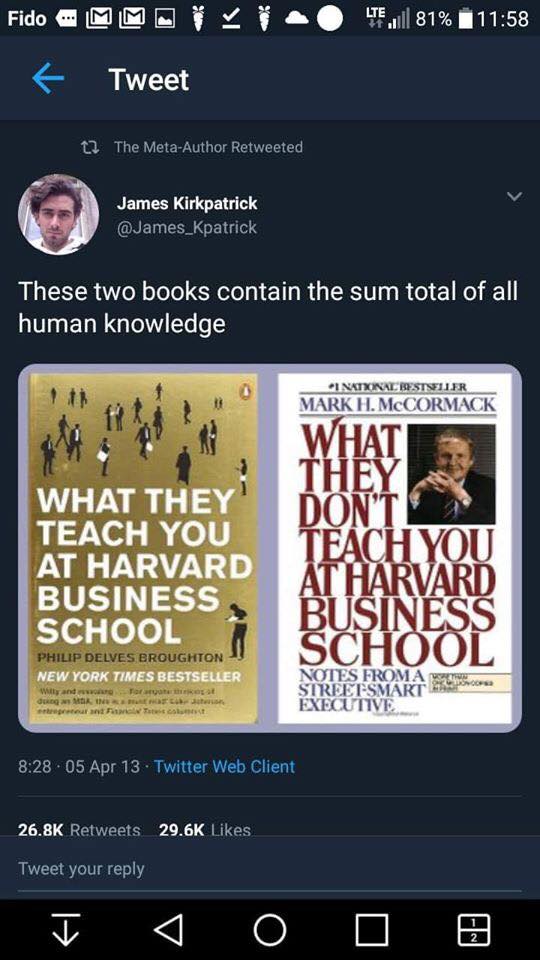
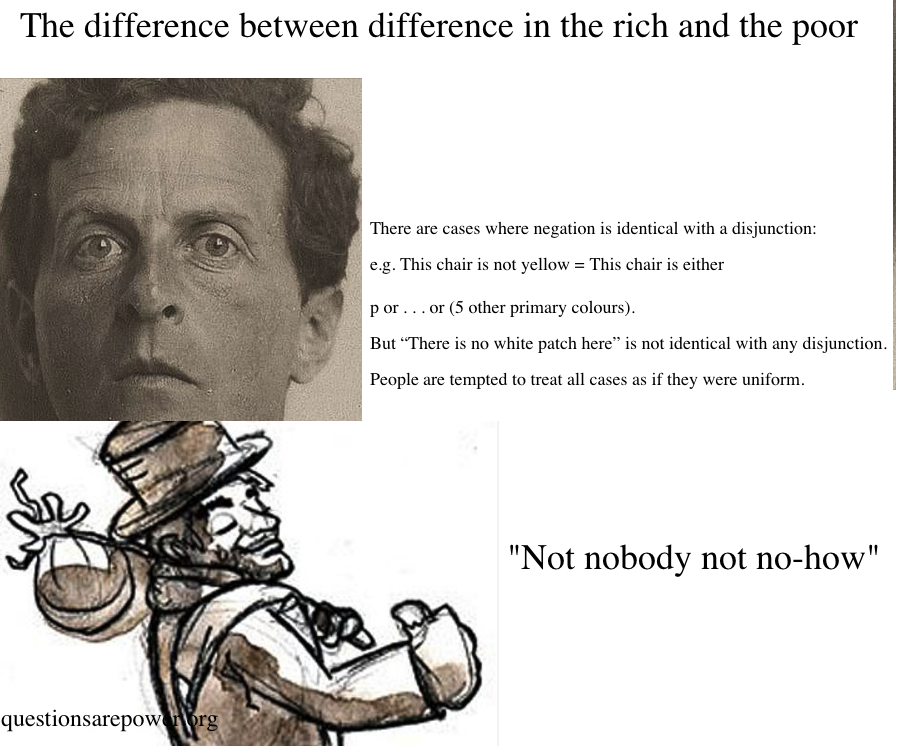
Should Ronald McDonald’s “Do you believe in magic?” be considered vandalism?

Having Jesus or Muhammad or science satirized in TV shows is done with peril, but unaffiliated mysticism seems to be fair game. As much as we might denounce identity politics, would it even be possible to escape? This is interesting because certain parts of unaffiliated mysticism are hard to argue with, such as the existence of love. How would someone with a recognized and politically defended identity fair if they were to reject this mystical idea publicly?

The Buddha’s Categories of Questions

Could the Buddhas Analysis of questions be ordered purposefully?

  1. Categorical (likeness, identity)
  2. Analytical (difference)
  3. The battlefield of questions, where one is countered by another until we either know what we mean, and fall into type 1 or 2 questions, or throw up our hands, unknowing, into type 4
  4. The Great Questions that can only serve to fill us with wonder. Is there something in wonder that can heal? Something that we need?

And which questions are we looking for? Categorical answers are still ideas to be released. And the Great Questions, inasmuch as they are framed by words at all, are to be released as well, but inasmuch as they are not framed, they are closer to the Original Ignorance that we are to mystically Know, or at least be aware of. Dispassionately. Not to be taken in. To know how to channel the energy of wonder so that it goes where it should.

The Saving Power of Work

“But in the area of the Dhamma, simply sitting still with the right intention is a form of work or action. Lying down with the right intention is a form of work or action. Sitting, standing, walking, lying down: All of our movements and postures, if done with the right intention, are a form of work or action. When our actions are right, we’ll experience peace and ease. And then how will suffering come our way? The reason we suffer is because our actions are wrong. We sit, stand, walk, and lie down in ways contrary to the Dhamma. And then when we take on other work in addition to our basic actions, that work is bound to turn into wrong action as well. This was why the Buddha improved his manners in how he sat, stood, walked, and lay down, so that they were all pure in terms of the intentions of his mind. What this means is that he kept practicing tranquility meditation in all his activities. His mind had to stay with what the body was doing. If the mind told the body to do something, but didn’t do it along with the body, then he didn’t succeed in what he wanted to do. He couldn’t let the body work on its own. The mind had to work along with the body. Otherwise, his old manners would come back and take charge of the mind.”

Ajaan Lee Dhammadharo, Right Action, Right Result, November 11, 1958

The Universal Truths

I am not a postmodernist because I take certain things to be universally true. There are only a small number of these.

  1. There exists a general notion or operation called “separation” This involves the decay, falling apart, or impermanence of mental, spiritual, physical, or any other qualification of phenomena.
  2. There exists a general notion or operation called “Union” you could equally call it “Equal” or “same” or “synthesis” “thing” or “gathering,” “Being,” “Idea,” or “word.” The reason for the many terms for Union is Union is vague, and words are vague. How and what joins together varies, but in general there most definitely is an operation, be it mental, physical, spiritual or whatever, that I call “Union”. Since “thing” is included in “union” all things are unions.
  3. There was no original Union or Separation. The coming together and falling apart has no beginning nor end.
  4. All Unions are subject to Separation. Separation is another word, as such it is subject to decay or falling apart. Do not cling to a particular notion of Separation, they are just as vague and impermanent as notions of Union. There is still a universal truth that all Unions are subject to falling apart, dissolution. The words in this description of Universal Truths are like rain water that has pooled long enough to have a clear drink. Soon, these words will drain away from anything serviceable.
  5. The process of union and separation is called “Time” or “Space” or “Mind” or “Spirit” or “Ether” or many others. The principle of the arising of Unions and their Separation accounts for the many names of this “process.”
  6. There is Awareness of Absolute Truth, this Truth is not really grasped with words or any other Union. The sixth truth could be simply called “Awareness,” It can be experienced through one of many doors such as a mental, physical, spiritual or other door. When it is experienced it is experienced in every way as well–as mental, as physical, as spiritual, and as any other way nameable. In other words, it is a special kind of Union. The 6th truth can not normally be maintained through “Time” or the 5th truth, except by equally grasping all 7 truths. Awareness of the first 6 truths can be achieved without meditation.
  7. There is ignorance of the Truth. This manifests as a lack of awareness: mental, physical, spiritual, or any other (un)nameable awareness. Ignorance of the Truth arises from over-attention or over-aversion to one way or some ways (but not all ways) of being aware. In other words, ignorance is excitement, zealousness, greed, aversion, passion, ecstasy, and suffering or any kind of uncontrolled, unrestrained energetic state involving some (but not successfully all) unions or universal truths. Ignorance is a lack of equanimity in your ability to experience the Truth, or application of awareness. It is the Separation of the 6th truth. The separation of the 6th truth is called “Creation of a Union.” Creation of Unions is the result of the 7th truth. It happens when there is no mastery or awareness of the 7th truth.
  8. There is full Awareness of the 7th truth. Awareness of the 7th truth does not result in creation of a Union. The 8th truth amounts to saying that none of these words adequately describe anything absolutely true. The 8th truth is Nirvana, and is experienced as the perfect maintenance, permanence, or continuation of awareness of the 7 truths. Mastery and Awareness of the 7th truth must be cultivated with some kind of meditation.

Essentialism and Logical Pluralism

A lot of my work can be reduced to the debate on essentialism, and of course, my book comes down on the side of non-essentialism. This is the idea that there are not universal ideas or categories to to label with a word. That language is not enough for inquiry or truth-seeking.

“When we define something, then, what we are really doing is drawing a circle around a set of objects. But this circle will always have blurry edges, because our language simply cannot be infinitely precise (nor need it be, most of the time).”

This looks like my consideration of Pierce’s circle as the only mark needed to do Aristotle’s logic.

The circle in this notation is the negation operation, or distinction. And I do argue that the marks used to make circles have blurry edges. I go a little further and say that because these logical marks have blurry edges, we can actually create different kinds of marks, that still count as a kind of distinction. Its like saying you don’t have to only use a scalpel or a pen to mark the circle around logical objects or reality to create identities or logical statements. There are many other tools you could use. Intuitionist logic has a different understanding of logical negation, so the way they mark the circle is different from the way Aristotelian logician marks a circle. And these are different from the ways paraconsistent logics slice up reality, in other words, paraconsistent logicians use different tools from just scalpels or pens to do their mental arrangements.

It is true that you can reduce these different tools to a single tool, for the most part. We would not be able to begin talking about different slicers that slice reality, (extending from the nonessentialist observation that there are different ways to slice reality) if we didn’t turn our scalpel on itself, or use another scalpel on it, to tamper with it and modify it. So you could say that all these tools depend on the scalpel. Doing that is like writing computer code and only using the if, then, elseif, else code for everything, without the many other tools like loops, and so many others. Or trying to talk about computers using only algorithms and no data structures, or vice versa. Pragmatically, it is better to talk about the different logics as different tools for slicing reality, rather than reducing them all to a single kind of scalpel.

Language is Lunch

In my book (2019 https://www.amazon.com/dp/1688505717) I make the case for why logic is changeable and therefore temporary. The crux of the argument is that the inequality between a lemon and a lime does-not-equal the inequality between a star and a question, which draws the concept of identity into question. This implies that everything changes, including language or how we slice up reality with words. It amounts to the Buddhist maxim ” everything is impermanent” including words and mathematical words/objects.

This is not to endorse nihilism. Language is still very helpful in learning truth, but truth is not something that can be expressed with language. See this blog post: https://questionsarepower.org/2020/03/22/the-fools-song/ Language doesn’t amount to nothing; it is like lunch. You need it to keep your mind going on its path to truth, just like you need lunch to accomplish much of anything in life. You read and think in language so your mind can keep moving. It is very important, even hypnotic. Ultimately, as a delightful art form, it is a means to an end. It is not an end in itself.

I should add that this requires a particular theory of identity: how it is like and different to other things is how it gains its identity. As usual, not a perfect theory. But surely, how we relate an apple to the rest of the world changes. Maybe over a thousand years we decide apples don’t taste good, or are dirty, or whatever else. It is actually easier to see how mathematical objects change, because our taste for them changes them even more than it does an apple.

The relationship between truth and questions

Are there some questions that you can accept or reject? If I reject this question, is it a question? Or am I merely answering the question by rejecting it? It is true that when you really answer a question, it is no longer in question. But how is that different from rejecting a question?

I think all questions involve words and terminology. You can disagree with the terminology used to ask a question. When you do that, are you rejecting the question? Can questions change and still be the same question? Can answers change and still be the same answer?

Suppose I ask “do you beat your wife or are you a sexual offender?”

Most people would disagree with the terms of this question, because the answer is usually neither, and that is not allowed with the English “or”

but only a minor change in the question: “do you neither beat your wife nor are a sexual offender?” makes the terms acceptable. The problem is not the question but the logical rules for “or” that we normally use to answer questions.

Perhaps the best model for the relationship between questions, truth and falsehood is the Jungian model for the relationship between the earth-tree, heaven, and hell.

Carl Jung: “No tree, it is said, can grow to heaven unless its roots reach down to hell.”

In this model we are all trees, as long as we are growing. So if we are asking questions, and asking questions about the terminology in our questions, we are like a growing tree, in the center of the universe. As these questions stretch towards the world, both vertically and horizontally, the tree grows, until its roots reach down into hell and its branches reach up into heaven. Heaven is the truth, hell falsehood. We cannot reach either without asking questions. Rejecting a question is denying growth to the tree, which is necessary to reach the truth, even as its roots continue to reach down into falsehood.

Manly Will

The concept of manly will in Buddhism combines Virya (manly) with Chanda (Will), where Virya is not gender-specific, it simply means “exertion of a strong human.”

“Chanda here means desire to act (kattu-kamata), that is to perform an action or achieve some result. This kind of desire must be distinguished from desire in the reprehensible sense, that is, from lobha, greed and raga, lust. Whereas the latter terms are invariably unwholesome, chanda is an ethically variable factor which, when conjoined with wholesome concomitants, can function as the virtuous desire to achieve a worthy goal. The characteristic of chanda is desire to act, its function is searching for an object, its manifestation is need for an object and that same object is its proximate cause. It should be regarded as the stretching forth of the mind’s hand towards the object.” Abhidhammattha-sangaha

I do not mean will for sensuality, including the desire for the vision of light, or for creation of desirable life. I want to oppose the type of will called “Chanda” with the analysis of qualities, the power of the mind, and subsequent power of the minds material contrivances, to divide concepts and materials. Analysis of qualities is the act of saying “no,” of making a distinction: “this is not that” or “not this, something else.” Chanda, on the other hand is the act of saying “yes”

“It’s a psychological “yes,” a choice, not a pathology” (Ajarn Succito)

The “principle of continuous…invention” that does not allow us to “rest content with a final act of devouring” on stage, but instead makes us continuously try to complete the stage itself, so that the play can begin “a place to stand” is the basic assumption that something can be invented from nothing. This is one of the most difficult problems Aristotle faces in his Physics, and offers a First Mover principle at the circumference of the universe (exactly where nothing begins) to explain this problem.

I don’t think I have ever seen something come from nothing, though. When I invent, things come from other things, put together or “caused” by other things. I have no example of something coming from nothing. It is not necessary that the universe began at all, it is simply necessary that it is to some degree here, now. That is the smallest requirement to avoid nihilism. To say that *if* it is *then* it began somewhere is to put the “then” before the “if” or to reverse causality.

So there is never a situation where the stage isn’t there and needs to be invented. Sure, it might not be the stage we want, we might want to build another stage, but that will only make us start inventing using the stage we already have. It is to do nothing very surprising, because the stage has been changing all along, and will continue changing after we’re done so that things will have to be invented just to keep it the way we want.

Now about the “devouring,” why is the “end” of the stage and play a destruction? What comes to mind is the many mythologies that have an end of the world. Fenris, the great hungry wolf that devours the sun and the father of the gods, Odin, does not begin evil. He is tricked and bound and exiled and made evil, though whether we are good or bad to him, whether his intentions are good or evil, does not change whether or not he will eventually grow to devour all of creation. What changes simply is whether or not this end of the universe is good or evil, and ultimately, neither make any difference. I mean, since we are here, we ought to endeavor to make the end of the world a happy, even blissful occasion, rather than something terrible.

And so the mystical confusion between a duck and a rabbit that Wittgenstein puts forward is the “good” kind of destruction. It destroyed the difference between a rabbit and a duck. It is Chanda, the opposite of “this, not that” Well, that isn’t much of a destruction at all, neither are consumed. It goes on doing whatever it did before, even if the “destruction” or synthesis or vagueness between rabbit and duck is preserved. It could be that the bonds of Fenris that hold him until the end of time are exactly of this type. One of the bonds could be “a duck that is a rabbit” just like one of the bonds is “the air that a fish could breath” which can only be found if a fish is confused or synthesized with an air-breathing animal.

Now, what is the significance of Fenris eating the sun and the All-Father? I think it is Chanda, the type of will other than that conditioned by lust (sexual production) or greed (light production) into something good, even if it means the end of such production. “Consumerism is a synthesis of commercial products and a person’s identification with “mine.”

Are you better or worse than others?

https://link.springer.com/article/10.1007/s12671-019-01281-w?fbclid=IwAR0y_k19gPaFkkCLKtQ3aGBI8_LWAN41RrhxRGSlT37TQIQXMueTQmDiqY4

There is the idea I originally heard from Alan Watts that whatever you are experiencing now is the same as the experience of total enlightenment. The difference is who you are in that moment, or the way you are interacting with the present moment. I don’t think there is any chance that a person eating babies is enlightened, but later that day he could be having a civil conversation and overlap with his “best self”. You may be talking to a person who is both “worse” and “better” than “you”. Who are the people giving the test? what premises are involved in a self-esteem scale, and who would accept those premises? What kind of person would a test giver be looking for in test-takers? There is the ancient and very troubling idea, mentioned by Feyerabend, that counting and measuring people is a way of endangering them.